
Four years have passed since the seismic upheaval that was Apex Legends Season 13: Saviors, yet the echo of that update still reverberates through every drop in the Outlands. It was May 10, 2022, when Respawn Entertainment flipped the switch on version 1.95, and the games never felt quite the same again. The launch day felt electric—server queues stretched like drop ship cables, and the community huddled in Discord voice chats, speculating about the hero who would shield them from certain doom.
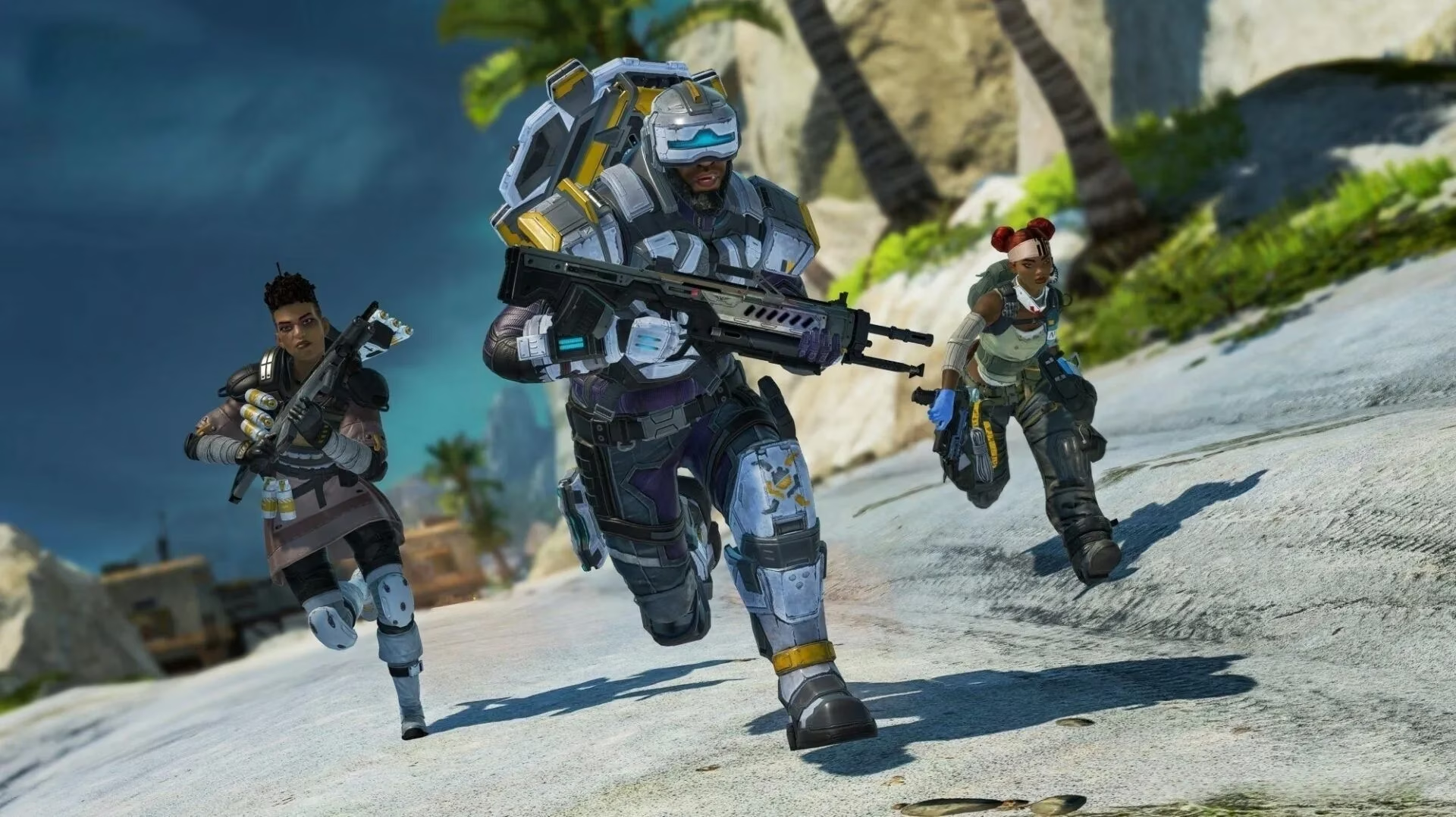
In those early hours, the legend select screen glowed with an unfamiliar silhouette: Newcastle, the Heroic Defender from Harris Valley. He arrived not with flashy portal tech but with a battered Knockdown Shield and an unbreakable resolve. The patch notes painted a picture of a support juggernaut built for the team-play renaissance that Respawn was about to enforce.
Newcastle: The Shield That Changed Squad Dynamics
Newcastle’s kit was a love letter to the protector fantasy. His passive, Retrieve the Wounded, let him drag downed allies to safety while his Revive Shield absorbed incoming fire. For the first time, a revive in open ground wasn’t a death sentence—it was a power play. His tactical, Mobile Shield, deployed a controllable energy drone that marched forward, a moving piece of cover that could redirect grenades and buy precious seconds. And then there was the ultimate: Castle Wall. The Knight-themed leap and slam created a fortified stronghold that split fights in an instant. Squads that once crumbled under third parties suddenly had a bastion. Watching a Newcastle player crash into a hot zone, walls erupting, became the hallmark of the season.
Yet, the legend’s arrival was only the headline. The real shake-up lay in the systems underneath.
Monstrous Map Update: Downed Beast and IMC Armories
Storm Point, the tropical colossus introduced in Season 11, received its first major renovation. Respawn promised to add without subtracting, and they delivered a PvE twist that still feels daring even in 2026. The Downed Beast POI was a colossal sea creature carcass washed ashore, its ribcage forming organic corridors and its gut a chaotic arena where squads fought amid lingering miasma. It replaced the sterile corridors of traditional arenas with something primal. Players learned to use bone ridges as cover and watch for snipers perched on its flared nostrils.
Scattered at four strategic corners of the map, the IMC Armories became high-risk, high-reward loot hubs. Activating an armory triggered waves of Spectres—reprogrammed IMC combat robots—that swarmed from every vent. Surviving the onslaught meant earning weapon attachments and gear specifically tailored to your loadout. A squad that cleared an armory could tilt the championship odds, but the noise attracted vultures. Those tense PvE interludes transformed the battle royale pacing, forcing teams to decide: secure the sweet loot or gatekeep the exit. By 2026, armories have been iterated on multiple times, but the foundational design born in Saviors remains untouched.
Ranked Reloaded: The Great Reset
If Newcastle was the heart of the update, Ranked Reloaded was its spine. Respawn finally introduced tier demotions, something the competitive community had begged for since the early days. The new system declared war on the \u201chardstuck\u201d phenomenon. Entry cost adjustments and a rework of Ranked Points (RP) killed placement mattered more than ever. The core pillars\u2014Teamplay for Victory and Accurate Skill & Better Competition\u2014forced squads to rotate intelligently, share resources, and prioritize the win over kill farming. Within weeks, the Apex ranked ladder felt ruthless but fair. Silver players who solo-pushed got demoted back to Bronze, while strategic trios climbed into Diamond with a grind that actually reflected their coordination skill.
The 2026 ranked ecosystem still carries those DNA strands. The removal of the 2-hour map rotation block that season was another subtle but meaningful change. No longer would a single Olympus session trap a player in a map they hated for their entire evening. Storm Point, Olympus, and World\u2019s Edge cycled smoothly, keeping the meta fresh.
Weapon Balancing: The Fall of the Kraber and the Rampage Reckoning
Balance changes in Season 13 felt like a sledgehammer. The Kraber\u2019s headshot multiplier was slashed from 3.0 to 2.0 and base damage reduced to 140, ending the era of one-shot-kill collaterals that could delete a full squad. Sniping became a skill of attrition rather than a lottery ticket. The Rampage, a menace with its charged-up fire rate, got a triple penalty: increased reload time (3.1s), worse handling, and it was tossed into the crafter, forcing players to spend materials if they wanted its oppressive power. The L-STAR and Devotion had their headshot multipliers reduced to 1.5 and overheat/reload windows stretched, pushing them firmly into niche territory. Meanwhile, the Spitfire returned to floor loot with a cascade of nerfs\u2014damage drop to 18, reduced mag capacity, and a removal of its barrel slot. It became a shadow of its former meta-defining self. The Mastiff, now a crate weapon, packed a denser blast with 14 damage per pellet but only 4 shots, rewarding pinpoint aim.
Helmets got a quiet but significant buff: blue headshot damage reduction jumped to 50%, purple to 65%. Suddenly, investing in a blue helm early felt like a shield upgrade, and the purple helm became a non-negotiable endgame pickup.
The Ripple Effects Through 2026
Looking back from 2026, Season 13 was the inflection point where Apex Legends doubled down on team cohesion and mechanical integrity. The Valkyrie jetpack nerf\u2014disabling abilities, weapons, and heals while out of bounds\u2014reined in the skyscraping predator who had dominated rotations. Rampart received a loving touch: Sheila\u2019s spin-up time shrank to 1.25 seconds, and Amped Cover deploy health doubled to 120, turning her into a viable anchor. Crypto\u2019s heirloom glitch fixes and Quality-of-Life improvements to the Custom Match system showed Respawn\u2019s commitment to the long tail. The custom match overhaul introduced team name saving, refined observer tools, and Anonymous Mode colors that esports casters still rely on today.
Yet, not everything endured. The Bocek Bow pricing adjustments in Arenas hinted at a mode that would eventually fade from competitive focus. The removal of the 2-hour rotation block was reversed in later seasons as player counts stabilized, but the memory of that flexible era remains fond. The Downed Beast eventually rotted further in lore, becoming a permanent skeleton landmark while armories evolved into mobile deployable events in Season 20.
For veterans who lived through Saviors, mention of \u201cNewcastle meta\u201d still sparks debate. Was his Castle Wall too strong? Did the Ranked Reloaded push away casuals? The numbers tell a story of reinvigoration: player retention climbed, and the \u201cteamwork over everything\u201d philosophy solidified. In a 2026 landscape dominated by holographic map hazards and Sentinel reworks, Season 13 feels like the bedrock of modern Apex\u2014a time when shields became more than HP bars and the champion squad felt truly earned.
So here we are, four years later, still picking up the Spitfire with a twinge of nostalgia and glancing at the sky for a Valk who learned to respect the boundary lines. The Saviors update wasn\u2019t just a patch; it was a manifesto. And Newcastle\u2019s armored silhouette, fading into the sunset of Storm Point, remains the emblem of a season that taught us all to protect what matters\u2014our squad.